
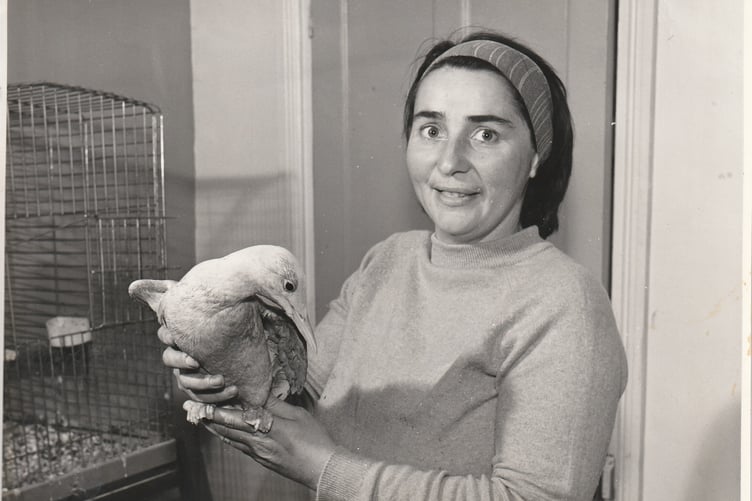
Conservationist and author Molly Burkett, who developed her lifelong love of animals while growing up in East Hampshire, has died aged 93.
Ms Burkett (née Preece) lived between Medstead and Bentworth from 1963 to 1969, having previously lived at Fiddler’s Field in Shalden and, earlier still, in a caravan on Lasham Airfield. Her children were born at Alton Maternity Unit.
An author of more than 120 books, Ms Burkett also ran one of Britain’s longest-running private wildlife rehabilitation centres, caring for sick and injured animals for more than 60 years. At its peak, the centre in Lincolnshire housed up to 400 animals at a time.
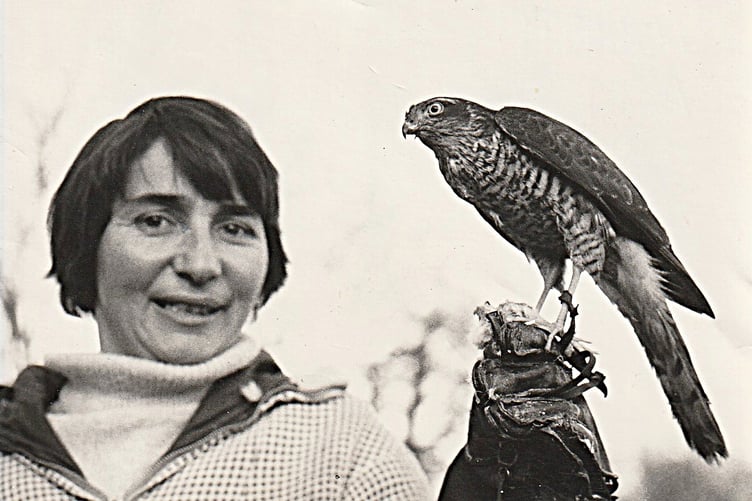

Life at home was famously unconventional. Seabirds recovered in the bath, owls in cupboards, badger cubs in laundry baskets, and swans, eagles and rheas roamed the garden. One of her best-known residents, Jack the Crow, noted for his fondness for beer, achieved national fame after appearing on That’s Life.
Born in 1932, Ms Burkett was evacuated several times during the Second World War. As a child she watched Jewish refugees arrive in England, was waved at by German pilots flying low overhead, and was once ordered to stay indoors after a bombing raid because lions had escaped from evacuated London Zoo.
After the war she trained at Goldsmiths College as a teacher and educational psychologist, later specialising in teaching disabled children. She taught at several schools and colleges, including Treloar College, and became involved in campaigning for equal pay for women teachers, helping organise marches to Downing Street and challenging ministers directly.
During the 1950s and 1960s, while living in East Hampshire, she and her husband John began taking in sick and injured wildlife. What started with falconry grew into a major rehabilitation operation, run on principle without opening to the public or accepting donations.
Ms Burkett pioneered techniques for rescuing oiled seabirds following the Torrey Canyon disaster in 1967, supplied captive-bred ravens to the Tower of London, and later advised the government on the Dangerous Wild Animals Act.
Alongside her conservation work, she became a familiar face on television between 1956 and 1967, appearing regularly on Zoo Time, hosted by George Cansdale, and later contributing to programmes including Animal Magic and Pebble Mill.
Her writing career began in childhood and ran in parallel with her practical work. Her first book was published in 1966, and she went on to write more than 120 titles, many inspired by her experiences with wildlife.
A tireless activist, Ms Burkett helped found the Arnhem Museum at Fulbeck, the Conservation Section at the East of England Show, and Lincolnshire Against Nuclear Dumping. In doing so, she was described by The Times as Britain’s first “nimby”.
In later life she served as a Home Office inspector for residential units for young people and homes for the elderly, and chaired the Home Office children’s board.
In 2008 she was awarded the MBE for services to wildlife conservation and education.
Ms Burkett is survived by her son, St John, and daughter, Sophie.
Comments
This article has no comments yet. Be the first to leave a comment.