
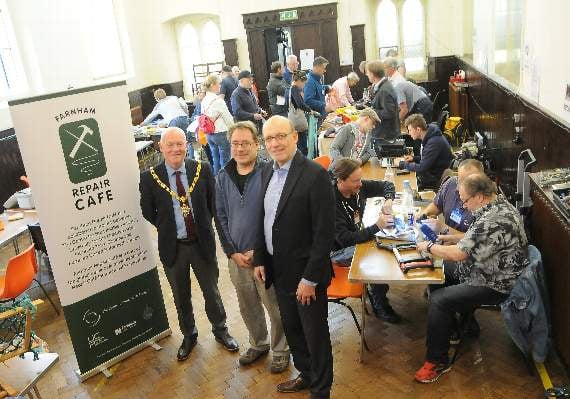
FARNHAM Repair Cafe will return for its 30th session this Saturday (November 11) hoping to continue the fight against today’s ‘throwaway culture’ and add to the estimated 1.14 tonnes of old and damaged products it has diverted from landfill since 2015.
The repair cafe, a community-led project between the Centre of Sustainable Design at the University for the Creative Arts (UCA) and Farnham Town Council, invites product owners to bring their faulty electronics, mechanicals, laptops, bicycles, textiles and furniture which are then assessed - and repaired, where possible - by volunteers.
Taking place on the second Saturday of every month at the United Reformed Church in South Street, the group’s latest session will take place between 10am and 1pm, and comes on the back of the group’s record-breaking 29th session in October, when it attracted a best-ever 74 people and repaired a record 31 items.
In total, Farnham Repair Cafe has now welcomed 1,211 visitors and fixed an impressive 63 per cent of the items put before its skilled volunteer repairers - saving almost ten tonnes of CO2 emissions otherwise expended disposing the goods, and recently registered as an independent charity.




Part of a global concept originating in Amsterdam in 2009, Farnham Repair Cafe is one of just under 1,400 groups registered by the Repair Cafe Foundation worldwide, but the first in the UK to be awarded charity status.
Explaining the roots of the group, Professor Martin Charter, director of the Centre of Sustainable Design and project leader, said: “It all started after I saw repair cafe founder Martine Postma speak at the Hannover Fair in Germany in 2014.
“All repair cafe workshops are community-led, so the drivers have not come from big business, but generally from local government or citizens themselves, and I thought to myself ‘this sounds really interesting’.
“We undertook the first ever global survey on repair cafes and the next step was to set one up ourselves. We did and it’s gone through a journey to charitable status.
“After spending the past 25 years working in sustainability, it often feels like pushing a big rock up a hill. But the beauty of the repair cafe, is people just get it and you don’t have to explain it. People love it, it makes sense.”
As well as product owners, Farnham Repair Cafe is backed by a large stock of volunteers, aged 17 to 75 years old, fulfilling a variety of roles from repairers to trustees and ‘data miners’ responsible for recording, among other factors, the weight of each item repaired.
This ‘data mining’ distinguishes the Farnham Repair Cafe from the majority of groups around the world and, using a formula developed by DEFRA, allows it to estimate its contribution to CO2 reduction.
As well as giving the group positive feedback, the UCA and Martin is also feeding this information back into his own research and upcoming book Designing for a Circular Economy, with the ultimate aim of combating ‘in-built obsolescence’ - which Martin describes as the idea that manufacturers build-in finite lifetimes to products, deliberately or otherwise.
He continued: “We track what sort of faults are coming in and what sort of solutions are applied, and because we’ve mined all the data, we’re starting to open up conversations with companies to share our data with them - with the aim of helping them change their design behaviour.
“Eighty per cent of a product’s environmental impact is determined at the design stage, and one of the classic things we see at the repair cafe is we get quite a number of vacuum cleaners that apparently don’t work, the guys unscrew it and get into it, and they’re just clogged up with muck.
“It’s a great example where a very simple design change by a vacuum cleaner manufacturer, to make it easier to take apart and clean its product, could extend the life of the product.”
Martin added he is beginning to see a behavioural change towards “making, modifying and fixing” - pointing to the popularity of amateur YouTube tutorials and the rise of companies such as E Spares selling spare parts direct to consumers.
To this end, Farnham Repair Cafe recently launched its own YouTube channel to share knowledge on repairing products, and adopts a #sharerepair philosophy encouraging product owners to observe the repair process at each session.
“Our research indicates that an estimated 50 per cent of visitors attempted a repair at home as a result of attending Farnham Repair Cafe,” added Martin.
As well as registering as a charity, which Martin says will provide “a more professional and higher profile platform for development and fund-raising”, the cafe is also taking tentative steps into art - proving that even un-repairable products can retain a useful purpose.
As such, Martin is particularly keen for anyone who is interested in Upcycling products to join its Creative Zone at this Saturday’s session - as well as welcoming volunteers with repair skills who want to fix a product or just want to network and learn.
The event is free and registration is not required. Visitors can bring up to three products to a repair cafe session but can only register one product to repair at a time.
For more information, email Ros on [email protected] or visit the website cfsd.org.uk/events/farnham_repair_cafe/.
Comments
This article has no comments yet. Be the first to leave a comment.