
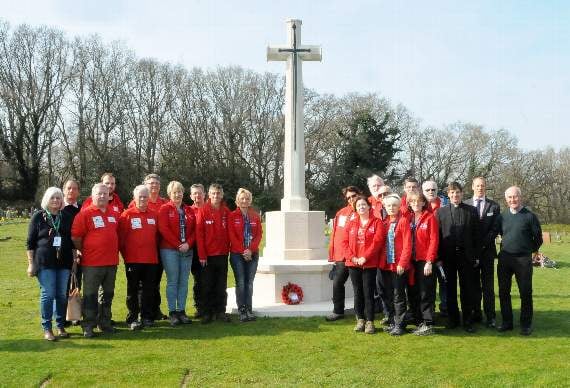
A MOVING pilgrimage from Nova Scotia to northern France in honour Canadian WWI hero Private John Arsenault stopped at Milford Cemetery on Monday during a special day of remembrance.
Private Arsenault joined up as a volunteer in 1916 and trained at Witley Camp before being killed in action on the first day of the battle of Vimy on April 9, 1917.
He was one of 3,600 Canadian soldiers who gave their lives as four Canadian divisions succeeded in retaking the vital ridge, where a national memorial has been erected to honour an astonishing victory.
Born in Cape Breton, Nova Scotia, on May 24, 1888, Private Arsenault had worked as a coal miner before the war broke out, but was conscripted into the 85th Battalion of the Nova Scotia ‘Overseas’ Highland Brigade.

He trained in the provincial capital of Halifax before embarking on the six day crossing to Liverpool in October 1916.
Private Arsenault spent a few months training in the Witley Common camp before being shipped out to the front in February 1917 – just months before the infamous four-day battle.
The Nova Scotia ‘Overseas’ Highlanders played a pivotal role in the capture of ‘Hill 145’, now the site of the Canadian National Vimy Ridge Memorial.
Sadly, Private Arsenault did not see the end of the bitter fighting, but his sacrifice, along with thousands of other brave Canadians, was not in vain.
Victory at Vimy Ridge became a defining moment in Canada’s history and is considered to be ‘the Birth of a Nation’.
To mark the 100th anniversary of the Battle of Vimy, commemorations organiser The Odyssee de la Culture, decided to follow the footsteps of Private Arsenault.
Pilgrims started out from Cheticamp in Nova Scotia, on March 19, and will arrive at the site of the iconic French battlefield memorial on April 8, in time for the start of the centenary celebrations, which will be attended by the Prince of Wales.
Key figures on the historic pilgrimage are two of Private Arsenault’s descendants from Nova Scotia – his great grand niece Dawn Morrison and her uncle William Bates.
Witley Parish Council, Rodborough School, Witley and Milford churches and many local businesses joined together to ensure the contribution they made to the pilgrimage would be truly memorable.
Monday’s programme started with a 9.30am service at All Saints Church, Witley, where Private Arsenault’s battalion left its colours for safekeeping when it embarked for France in 1917.
Members of the pilgrimage then walked to the National Trust’s Witley Centre to see where the training camp was based, and then to Milford Cemetery, in Haslemere Road, for a service of remembrance at the war memorial led by Milford vicar Rev Clive Potter. The Odyssée also mounted an exhibition at Godalming Museum.
Dawn told The Herald at Monday’s afternoon service it was not the first time her heroic ancestor had made the headlines.
“His British War Medal was sent to his family on his death but it was lost and then miraculously found 40 years later,” she said.
“John was 40 when he died, but he left no wife or children and if The Odyssee had not chosen him, his story would never have been told.
“This is my first time in the UK and it means so much to us to be walking in his footsteps.
“We are very honoured and are learning so much along the way about the incredible sacrifices he and his fellow soldiers made for our freedom.
“Hearing about John is remembering all the soldiers who died.”
The Canadian soldier’s descendants laid a wreath at the service in the cemetery, which was attended by Witley parish councillor Louise Mills, Rodborough deputy head Chris Williams, Odyssee representatives and members of the Ramblers Association, who also joined the walk.
Chairman Patrick Stewart said: “Witley Parish Council is very happy and proud to be involved with this worthwhile project. I am particularly pleased to see the individuals taking part in the walk are receiving support from so many people and organisations within our community – schools, churches, businesses and others.”
Mr Williams told The Herald: “Rodborough is trying to keep memories of the WWI and WWII training camps alive for our pupils.
“The school has a Canadian memorial garden and a maple tree was planted in the main playground.”
Comments
This article has no comments yet. Be the first to leave a comment.