
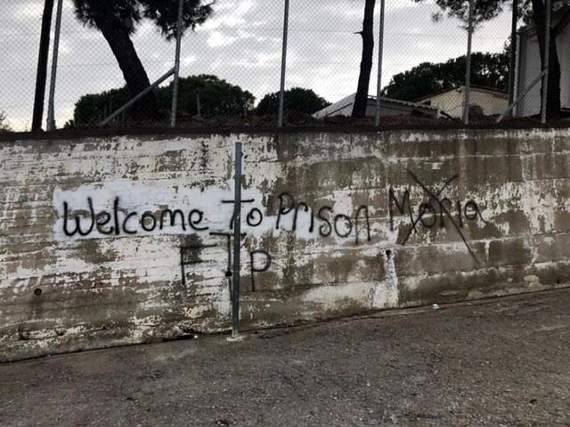
“ONE of the most difficult things was that it’s in Europe. The richest part of the world and yet these people are being kept in just diabolical conditions.”
That was Trish Chipman’s reaction to the conditions in Moria, a refugee camp in Lesvos, Greece, when she made her first visit in 2016.
Since then she has returned twice, most recently with her husband John when they combined a holiday with working at the camp.
Trish, a 52-year-old occupational therapist from Farnham, volunteers with EuroRelief and helps to distribute the food, welcome new arrivals, give them their first set of clothing and basic essentials, help at the information centre and with ‘housing’. ‘Housing’ refers to finding space to put up a little tent to house new arrivals or settle a family group.
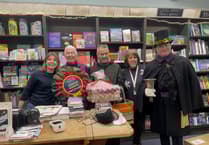
During her recent visit, she spent ten hours with an unaccompanied 14-year-old boy in hospital who had been “beaten up” while in Turkey. He was said to have “residual injuries” and so Trish spent the day holding up his drip stand.
She spends time interacting with the children and spoke of one “delightful experience” with an eight year-old boy who’d never been to school. He wanted to know where Trish was from and so they found a “scrap piece of blue tarpaulin” and collected stones to make a map of the world.
Trish and John spent time with a group of unaccompanied young teenagers playing card game UNO, which she said was “heaps of fun” and seeing “these guys who’ve been through so much having some fun and smiling is just so heartwarming”.
Although there are showers and toilets in the camp, they are reportedly in an “appalling state”.
There are currently around 70 people to a toilet and about 85 people to a shower, according to Trish, but the lack of water makes them “unusable” – water runs for only two to three hours a day.
Trish worked with one elderly lady in her 90s who had walked from Syria. She said “knowing she’s got to go and use really atrociously awful facilities is just heartbreaking”, adding “in a way that was quite shocking”.
Women are apparently “fearful” of using these facilities, particularly with children, as “it’s not safe”. More recently some of the smaller non-governmental organisations (ngos) have started to provide showers for the women – there are ‘Showers for Sisters’, ‘Shower Power’ and another called ‘Gateways for Life’.
The ngos have built these shower units away from the camp and use minibuses to fetch the women, who book an appointment using WhatsApp (phones are their “lifeline”). It gives them “an hour or two of humanity”, and “for a lot of the Muslim women it’s the only time in an all-female environment they can take their headscarves off”.
According to Trish, ‘Shower Power’ is looking to expand to provide another unit for men, while ‘Showers for Sisters’ has spoken about having an afternoon or evening slot for dads who are single parents.
Trish said: “Even though there are three organisations doing that, it’s still a drop in the ocean compared to the numbers in the camp.”
An organisation called Love Lesvos has started a project making ‘dignity packs’ for ladies which they can pick up when they go for their shower. Each pack contains shampoo, shower gel, underwear, some female hygiene products and a hairbrush.
This is a project which Trish would “love to promote” and thinks a collection of dignity packs in Farnham would be “great”. She and her husband saw some of the packs, which had already arrived in Lesvos, being put into use.
As well as the “lack of anything to do”, another “shocking” experience for Trish was the “severe overcrowding” and the “squalor of the camp”.
According to the UNHCR (United Nations High Commissioner for Refugees), Moria has a capacity of about 2,800.
Trish told the Herald that at the moment “on the island there are around 10,000 refugees, but in the camp itself there are 9,000”, describing it as being “horribly overcrowded”.
She added there were also “at least about 2,000 people who are now living in the olive grove outside the camp as well because there is just no room inside the camp”.
By the time of Trish’s second visit, she said it was “clear their mental health was deteriorating rapidly”, having already “experienced such trauma” and now being “stuck” on the Greek island.
Trish was inspired to make her first visit to Lesvos after investigating the refugee crisis.
She decided to make contact with EuroRelief after speaking to one of her Facebook friends, who had been out there doing some work, about how to get involved.
She said: “Just hearing about the refugee crisis and the suffering people are going through just touched my heart at first.
“Quite a lot of it has to do with my Christian faith.
“I just feel, as a Christian, I should be showing God’s love, welcoming the foreigner who’s in distress, helping the orphans and the widows.
“I really felt motivated from then on and the more I looked into it, the more I knew I wanted to be involved, I wanted to help them.”
Trish continued that she would “definitely encourage people to go”, but that “you do have to work out what your motivation is to go”.
She said: “You’ve got to go with the heart to give, to serve, to love people rather than just to go and see the situation.
“I think you also need to have some sort of resilience and know you can handle a situation where people are really suffering, where conditions are really, really poor.”
Having now been to camp Moria three times since 2016, Trish told the Herald her “heart is out there so much, which is why my husband and I ended up taking a holiday there”.
She added: “I couldn’t think of
anywhere else I wanted to go but to go back there because my heart is there.
“It’s such a desperate situation and people are having to live with such a lack of basic humanity.”
Comments
This article has no comments yet. Be the first to leave a comment.