
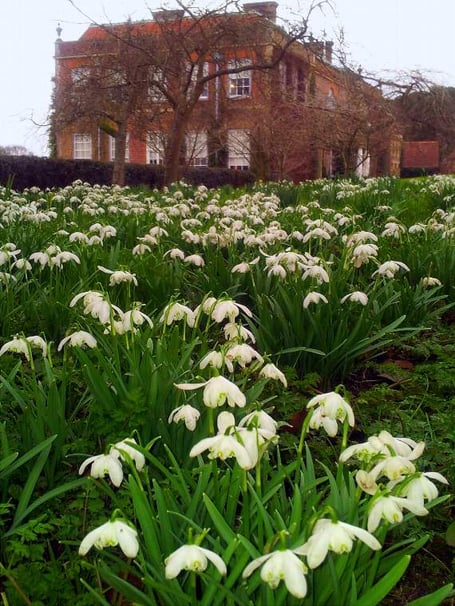
The delicate white snowdrop traditionally heralds the end of winter and acts as a reminder of brighter spring days to come.
From late January to early March, displays of these spring harbingers start to appear at National Trust properties across the country, including Hinton Ampner, Mottisfont, and The Vyne in Hampshire.
National Trust gardener Stephen Herrington said: “It’s always a joy when the first snowdrops break through the frozen ground. Along with aconites and primroses, they are the harbingers of spring. They are best seen in half-light and, of course, amid the winter snow. On mild, late-winter days, they are beloved by honey bees.”
* Hinton Ampner, Bramdean, near Alresford



Visitors will find hundreds of delicate snowdrops beneath the trees on the East Lawn at Hinton Ampner which, even in the depths of winter, is full of scent and colour.
Hinton’s previous owner, Ralph Dutton, designed the East Lawn of this garden around the tiny parish church in the grounds. He knew that even in the colder months the church’s congregation would gather on the grass after the Sunday service, so he planted the church border with fragrant winter flowers such as daphnes, which have a zingy lime scent and tiny pink flowers.
There are pretty hellebores too, as well as the golden-flowered cornelian cherry. Hedging of sweet box sarcococcas fills the air with a heady honey scent. Elsewhere, you’ll discover delicate winter aconites and colourful crocuses.
For opening times, visit nationaltrust.org.uk/hinton-ampner or call 01962 771305.
* Mottisfont Abbey, near Romsey
Snowdrops appear along the banks of the Font stream of this ancient former priory, where the warmer water creates its own micro-climate. Elsewhere, the open acres of the river garden are littered with clusters of purest white.
Mottisfont also contains the National Trust’s newest winter garden, exploring the potential of plants that are at their most beautiful and interesting when most are in hibernation. The garden blends a number of unusual varieties that are rich in colour and scent.
Gullies of foliage plants appear to wind through the banks of willow and spill into the stream. As winter creeps in, the garden becomes a refuge for late-flowering shrubs such as mahonia, bright-stemmed cornus and silvery rubus, sweet-smelling winter honeysuckle and daphne.
For opening times, visit nationaltrust.org.uk/mottisfont or call 01794 340757.
* The Vyne, near Basingstoke
One of the first sights to meet visitors in early February is a pretty ribbon of pearly white snowdrops that appears at the entrance to these gardens. Further snowdrop displays can be found in the wild garden, mingling with spring snowflakes.
Look out also for floral gems such as yellow winter aconites and candy-pink viburnum, and if you peer upward into the trees you’ll see great clusters of mistletoe covered with pearly berries.
Winter is also a great time to indulge the olfactory senses, so seek out the delicious fragrance of flowering daphne and mahonia.
For opening times, visit nationaltrust.org.uk/vyne or call 01256 883858.
* Tea rooms and shops are open at all the properties listed above in February, but house opening dates and times vary. Please check before you visit. To plan a family day out with the National Trust, visit nationaltrust.org.uk/southeast.
Comments
This article has no comments yet. Be the first to leave a comment.