
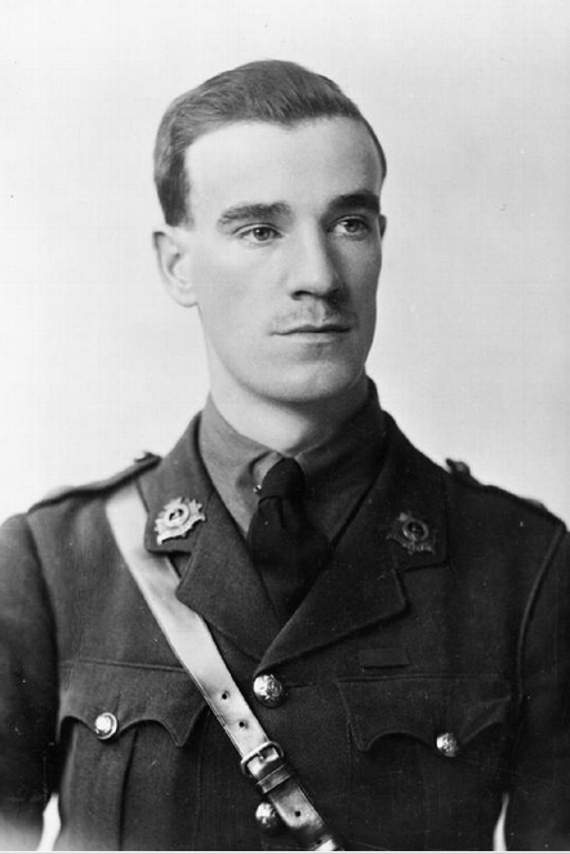
AT the commemorative service at France’s Thiepval Memorial to the Missing of the Somme last Friday, exactly 100 years after the opening day of the five-month battle, Blackmoor soldier Tom Adlam’s words were read out across the fields were hundreds of young men lost their lives.
Second Lieutenant Adlam was awarded the Victoria Cross for his courage while fighting less than a mile away from the memorial in Picardy, northern France, during the First World War.
His son Clive Adlam, 87, took to the podium at the service to read out - to the 10,000-strong congregation which included Prince Charles, Prince William, Prime Minister David Cameron and French president Francois Hollande - his father’s description of the battle.
“There was a job to be done and you just got on and did it,” Clive Adlam read.




Tom Adlam VC, a bombing officer who served with the 7th Battalion Bedfordshire Regiment during the Battle of the Somme, was also honoured at a service at the former REME camp gymnasium, on Bordon’s Budds Lane, on Sunday.
More than 200 people - including Clive Adlam and representatives from Whitehill Town Council and the Bordon and Old Basing branches of the Royal British Legion - gathered to remember the gentle school master who, although twice wounded, led his men to capture a German outpost during the Battle of the Somme (July 1 to November 18, 1916).
On the morning of September 27, 1916, 2nd Lt Adlam found himself leading an attack on the right flank of an assault on the German trenches, as the British tried to advance on the village of Thiepval.
His objective was to take the trenches to the right of the German position, while the main British force attacked the centre.
Under heavy fire, the initial assault faltered and 2nd Lt Adlam had to make his way from shell hole to shell hole under continuous enemy fire until he reached the officer leading the frontal assault, who suggested they remain under cover until darkness and then retreat.
But, instead, 2nd Lt Adlam returned to his platoon and, using grenades, led a daring attack to gain a foothold in the trenches directly in front of the German position. With a bullet wound to the leg and little ammunition left, he continued to attack using the Germans’ grenades, left behind in their trenches.
By the end of the day, 2nd Lt Adlam, with his small band of men, had succeeded in capturing the whole German position, which the main body of British troops had been unable to infilttate. Despite a second wound to his right arm, he continued to throw grenades and refused to leave the front for a further two days until ordered to do so by his commanding officer.
His citation, when he was invested with the VC by George V at Buckingham Palace in December 1916, read: “His magnificent example of valour, coupled with the skilful handling of the situation, produced far-reaching results.”
At the end of the war, 2nd Lt Adlam became headmaster of St Matthew’s School, in Blackmoor, where he and his wife Ivy raised four children - Josephine, Roger, Stephanie and Clive - while living in the school house, which they called home for more than 50 years.
At the school, Mr Adlam was known as “the boss” by the children and, with a keen interest in outdoor activities, he encouraged the pupils with their gardening plots and sports, with the athletic teams winning many cups.
Called back into service in the Second World War, he gained the rank of Lieutenant Colonel. He chose to leave the Army for the tranquility of his country home in Blackmoor and died in 1975 at the age of 81. He is buried at St Matthew’s Churchyard.
Clive Adlam read part of his father’s citation at the service in Bordon on Sunday and spoke movingly of his father’s valour as a soldier.
The service was conducted by the Rev Wendy Mallas, former Chaplin of Bordon’s Garrison Church.
The vicar of Blackmoor, Reverend Dominic Clarke, gave the sermon, comparing the courage of Tom Adlam, which had shone through the darkness of the First World War, with that of the light Jesus brought to the world.
2nd Lt Adlam’s memories, which his son read out at the service in France, included the description of how the soldiers “had a whole load of bombs ready” and “charged up the trench like a bunch of mad things”.
“I was frightened,” he wrote. “I don’t mind telling you.”
But he added, and as his son read: “There was a job to be done and you just got on and did it.”
Comments
This article has no comments yet. Be the first to leave a comment.