
IT can come as quite a shock to receive a letter headed, in big black print, “Hampshire Constabulary” and informing you that you have been caught breaking the speed limit in Selborne.
It means you have been clocked by the village’s Speedwatch team exceeding the 20mph limit, and the official letter can be a powerful deterrent.
Knowing that two or more police officers may call on you to warn you about your driving, may make motorists think twice before putting their foot down through the village.
To have this police backing is a valuable weapon for a team who have been valiantly trying to stop speeding along the very narrow High Street which has, on average, 9,000 cars passing through it each day, according to Speedwatch and other village groups.


Any speed over 20mph is putting villagers at risk.
At peak times, crossing the road can mean a five-minute wait or pedestrians risk injury just by walking along the pavement.
“I have been brushed by vehicles as I walked along the pavement,” said David Newth, Speedwatch co-ordinator. “And most days we pick up wing mirrors and car trims where vehicles have come close to walls and fences along the street.
“The other worry is young mums walking along with wide pushchairs on the narrow pavement, with a toddler’s head the right height to be hit by the wing mirror of a passing car.”
Only a month or two ago the school crossing patrol lady (Selborne has a Church of England primary school), who loved her job, quit due to the perilous road.
David said: “She became frightened because the traffic wouldn’t stop, even with the crossing lights flashing for the children to cross.
“Daily she was in danger of being run over as the traffic didn’t slow down.”
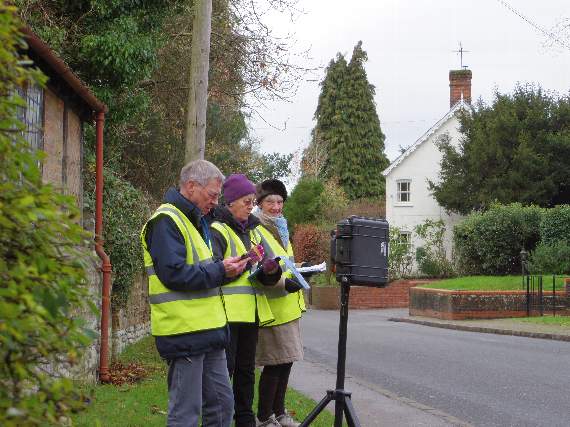
The village’s small band of Speedwatch team members - there are around 11 or 12 and all are volunteers - have been in operation for just over three years after Selborne Parish Council finally got permission from Hampshire County Council to have a 20mph limit on its High Street.
It was resident Jo Graham who, after discussion on the Selborne Village Plan, proposed the setting up of a Speedwatch team to ensure the 20mph limit is observed.
Selborne Parish Council bought the equipment needed, a radar gun and PalmPilot, which Oakhanger villagers can also use, to help clock speeding vehicles.
The team of volunteers were then trained by police on how to operate their Speedwatch. They were also advised on which location they could operate it from as, in terms of safety, not all places were suitable along the picturesque High Street.
As they move to different locations each time, it can come as a surprise to motorists who think, just because the Speedwatchers are not at the entrance to the village or in its centre, that they will not be there at all, and drivers can be caught by the volunteers just before the 30mph limit.
The Speedwatch team are a brave lot because many motorists are abusive or, according to David: “They yell out things like: ‘Why don’t you get a life?’”
David and two other members of the team, his wife Pam and Jan Earney, met me in the Newth’s elegant dining room, which looks out onto the ever-moving steam of traffic which, thanks to secondary glazing, can not be heard in the house.
Jan explained how the team - they usually have three on duty each time - operates using the radar gun to check a vehicle’s speed.
“And I have the PalmPilot to make notes and check the car registration,” she said.
“And we have printed forms on which we record the whole thing - time, registration, make, model colour and, of course, speed. Then, one of the team, Terry Cartwright, takes them into the police station and the numbers go onto the police computer and then the letters go out to the car owners to tell them they have broken the speed limit.
“We don’t have favourites and sometimes we catch residents, and also one or two of our own team, breaking the limit, and they all get recorded and reported.”
It is not easy catching a speeding car because they come through in a fast long line, she said.
“We yell out the reg number and note it down as quickly as we can,” she added. “Jenny Thompson is our registration queen and we also have a young mum, Diana Bands, whose children go to our village school.”
They work in shifts on different days but sometimes they do a full day’s watch.
One deterrent that stops traffic speeding is the parking outside the village shop.
“People complain about it,” said Jan. “But it does slow things down.”
Opposite is the village hall and Pam outlined just how difficult it was, and frightening, trying to get across the road to attend the weekly classes held there, or events like a jumble sale, fete or a social occasion.
“You have to take your life in your hands getting across sometimes,” she said. “And it isn’t always easy when you are carrying thinks like paint brushes and an easel going to the art class, or other things you might need to take for other events.”
It was the Thatcher government that sealed Selborne’s traffic fate, in the early 1980s. To provide a northern route to transport cruise missiles to Greenham Common (Berkshire) the then rural B3006 was widened up to the village.
Also, the Ham Barn roundabout was built for the lorries carrying the missiles to have easy access up through Stairs Hill at Greatham and down to Selborne.
In giving easy access to the military vehicles, the changes also provided easy access for commercial traffic and a faster route to Alton and Basingstoke.
The missiles have long passed through, and so both the Speedwatch team and residents agree there is no need now to have an easy access from Ham Barn to Selborne.
The team have been looking at ways of diverting traffic from the village or, at least, slowing it down.
“There is a scheme called shared space,” said David - who moved from Ripley, Surrey, to Selborne eight years ago. “This does away with pavements and has cobbled areas so drivers aren’t too sure just where the road is and, as a result, they slow down to check where they are going.”
Another thing that would help the group, said Jan, who moved to the village from Farnham more than 10 years ago and whose husband Gren is one of the team, “would be for Hampshire County Council to change its mind on demolishing the bridge at The Butts at Alton, putting a wider one in its place, which will have the effect of increasing traffic on the B3006 by80 per cent”.
“Instead, it should build a northern bypass which would take the traffic, especially HGVs, away from Selborne but I expect it thinks it is too expensive.”
In his November report, Terry (Cartwright) gave the gloomy news that, in spite of increased watch sessions being held, there is “little impact on reducing speeding”.
“We are catching more drivers but this is seemingly not acting as a deterrent,” he said. “We record more than 300 speeders a month but with 9,000 vehicles going through Selborne each day this is a drop in the ocean.
“These motorists receive a warning letter from Hampshire Constabulary but while it might deter the recipients from repeating their transgressions, it appears to have little overall effect on speeding. Sadly the police, because of constraints on manpower resources, are unable to give us as much support as we would like.”
Selborne Speedwatch members have the right to feel a little dispirited on hearing such news, but they must congratulate themselves on being the most successful village team in the area.
Even if they prevent one child from being injured as they walk to school, or an elderly person being “brushed and knocked down” by a car coming too close to the pavement or a collision of cars speeding round the narrow entrances to the village, they are doing a good job.
Taking a bow are the rest of the Speedwatch team – Janet Egan, Geraldine Dawson, Caroline Rye, Nick Lees, Ronnie Davidson-Houston, John Fuller and Steve Scott.
Comments
This article has no comments yet. Be the first to leave a comment.