
SURREY has been ranked as one of the worst counties in England and Wales for generating renewable energy.
According to the Green Alliance’s new renewable energy ‘league table’, Surrey came 51st out of 55 counties for harvesting energy from solar, wind and other renewable sources.
The study found Surrey has the capacity to produce 73 megawatts (MW) of electricity, compared to leading county North Yorkshire’s 1,613 MW and neighbouring Hampshire’s 410.5 MW.
Surrey falls particularly short at harvesting biomass for heat (52nd out of 55 counties), generating electricity from biomass and waste (53rd) and producing energy from onshore wind (54th).



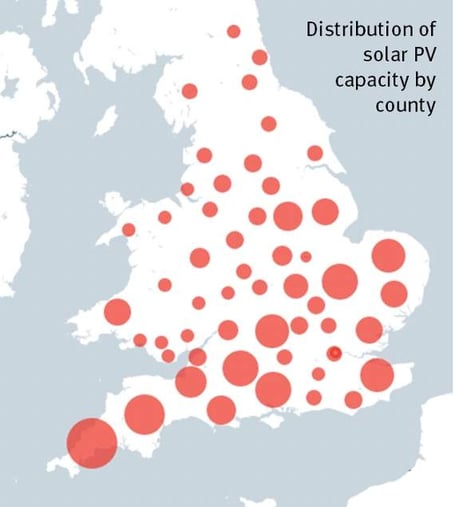
It also ranks just 43rd for harvesting solar power for electricity, despite this providing the vast majority of Surrey’s renewable energy at 37 MW. There are 8,288 solar panels in Surrey compared to 21,706 in Hampshire.
The only categories where Surrey ranks in the top 20 nationally are heat pumps (15th) and using solar power for heat generation (10th).
Responding to the news, a spokesman for Surrey County Council said: “We have more than 40 sites in Surrey that generate their own energy from renewable sources and we are currently looking into how we can provide even more of these to increase the amount of renewable energy the county produces.”
Neighbouring Hampshire ranks ninth overall for its generation of renewable energy, and third for harvesting solar power for electricity.
Hampshire has seen an explosion of solar farms in recent years, with notable additions near Farnham in Dippenhall and Bentley, and more recently at Eveley near Winchester where a new solar array is set to generate enough electricity to power the equivalent of 15,000 homes.
The county’s success was welcomed by Geoff French, chairman of the Enterprise M3 Local Enterprise Partnership, who said: “The use of renewable energy, particularly solar power, is rapidly gaining momentum and we are proud that Hampshire is at the forefront of this movement.
“New homes built as part of the regeneration of Whitehill and Bordon will be constructed to the highest environmental standards, including many with solar panels.
“Clearly there is still plenty of work to do to reach national targets around renewable energy use but the Enterprise M3 LEP is committed to supporting this work through promoting sustainable technologies and balancing economic growth with a well-protected environment.”
Martin Heath, director of Hampshire’s Renewable Energy Co-operative, added: “Hampshire is one of the country’s sunniest areas and it is brilliant to see us third in the league table. But we are also one of the highest per capita users of electricity as well, so we need to make the most of the tremendous potential in Hampshire for more renewable energy.
“We have some of Europe’s best tidal resources in the Solent and wonderfully windy areas off our coast. Hampshire is England’s most wooded county so we have lots of biomass as well. In fact, Hampshire is blessed with some of best renewable resources in the UK – we should be aiming to be number one.”
The think tank Green Alliance has just launched an interactive website, the Renewable Energy Locator, allowing people in England and Wales to explore how different types of renewable energy are doing in their local area compared to others.
It reveals sunny Cornwall and windy East Riding of Yorkshire are the top counties in England and Wales for installed solar and wind power respectively.
Cambridgeshire is possibly the ‘greenest’ county in England and Wales, as the only county to make the top 10 for both onshore wind generation (third) and solar power (fifth).
And there is a strong north-south pattern, with northern England performing better on onshore wind capacity and the south doing better on solar.
The renewables industry is also an increasingly important source of jobs, with more than 10,000 in the South East, including more than 3,000 in the solar sector. There are 120,000 people employed in renewables across England and Wales, including 30,700 in solar.
And according to Amy Mount, senior policy adviser at Green Alliance, renewables are now core to the UK’s electricity system, providing a quarter of the country’s power in 2015.
She said: “The distribution of onshore wind and solar revealed by the league tables show that counties are playing to their strengths.
“Most of the wind power is clustered in the windiest sites, generally coastal areas, and anyone who regularly staycations will tell you the South gets more sun than the North.
“What this shows is that, while funding for renewables is constrained by national policy, developers are tending to favour the sites that maximise their technology’s potential.
“It also means these are the places which will suffer the drop in construction activity due to the current block on subsidy free wind and solar.
“But solar panels generate power even on cloudy days and, as a blustery island nation, there are many spots right across the country capable of generating a substantial amount of energy from wind.
“Yet, in the March Budget, the government did nothing to clarify the future of these vital technologies. In the meantime, families and businesses are paying for more expensive, high carbon energy.
“There’s much more we could, and should, be doing to make the most of our great British weather.”
Comments
This article has no comments yet. Be the first to leave a comment.