
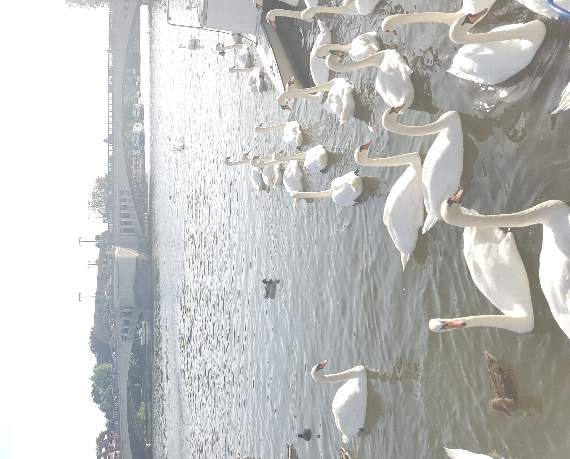
ALTON’S King’s Pond is a little less crowded following the assisted departure of six young adult swans.
Following the death of a swan on the road near the pond, the young birds have been re-homed on the Thames near Reading, Berkshire, where they will be free to grow and develop in less confined surroundings.
According to Alton Town Council, the decision to contact Swan Support followed concerns over the well-being of the birds after a swan was hit by a car on the road close to the busy junction with Wilsom Road and Papermill Lane and subsequently died.
It was recognised that the young birds were suffering from the behavioural patterns of the lead male swan as he tried to establish a territorial boundary to keep his adult progeny away from his mate and their cygnets.



In consultation with naturalist Dr June Chatfield, and with concern raised at the town council’s open spaces committee meeting over the safety of both swans and motorists, the decision was taken to contact Swan Support, a voluntary organisation that rescues, treats and cares for sick and injured swans within the Thames Valley and surrounding areas.
Negotiations were embarked upon with a view to rehoming some of the young adult swans, an exercise which required the consent of the Queen’s Swan Marker.
This consent was granted and six young birds were removed last Thursday, leaving just the mated pair and five cygnets on the pond.
Speaking after the event, Wendy Hermon, of Swan Support, confirmed that it was natural for swans to chase off their young once they begin to reach adulthood and that they would normally fly off to find a space of their own.
But for the King’s Pond swans this had not happened. They were quite comfortable because they were being fed by visitors and there was no real incentive for them to go, other than the fact that the dominant male was constantly and aggressively chasing them off the pond.
It was, said Ms Hermon, a double edged sword – because they had known nothing else, and because the pond was small and reasonably isolated from other stretches of water, and people were feeding them, they were relatively content. But if people had not fed them there may have been more fatalities as they strayed onto the road in search of food, being unable to get onto the pond.
“While it is a sad story,” she said, “in this case it has a happy ending.”
According to Ms Hermon, this year had revealed an unusual breeding pattern among swans with fewer cygnets on the Thames, possibly due to problems with flooding, but also the threat imposed by mink. However, elsewhere, such as King’s Pond, cygnet numbers appeared to be up.
She explained that it was normal for adult swans to chase their young away once they began to mature, and that this can be from as early as October or as late as March, so this season’s cygnets may also, in the long term, need to be rehomed.
In the meantime, Alton Town Council has expressed thanks to Ms Hermon at Swan Support and town resident Terri Quincey for their assistance in raising the alarm and ensuring the six young adult swans were safely re-homed.
Comments
This article has no comments yet. Be the first to leave a comment.