
THE poignant story of how three Elstead brothers all died in the First World War - the first soon after the outbreak of war and the last just days before the end of hostilities - has emerged as part of a project commemorating the centenary of the signing of the Armistice.
The tragic tale of brothers Arthur, Colin and Edwin Burchett has come to light after silhouettes of ‘silent soldiers’ were erected across Elstead to honour the 38 men of the village who lost their lives during the 1914 to 1918 conflict.
These silent soldiers are present across the UK in a campaign being led by The Royal British Legion, inviting the public to engage with the soldiers who returned home ‘silently’ on a personal level and pay their respects.
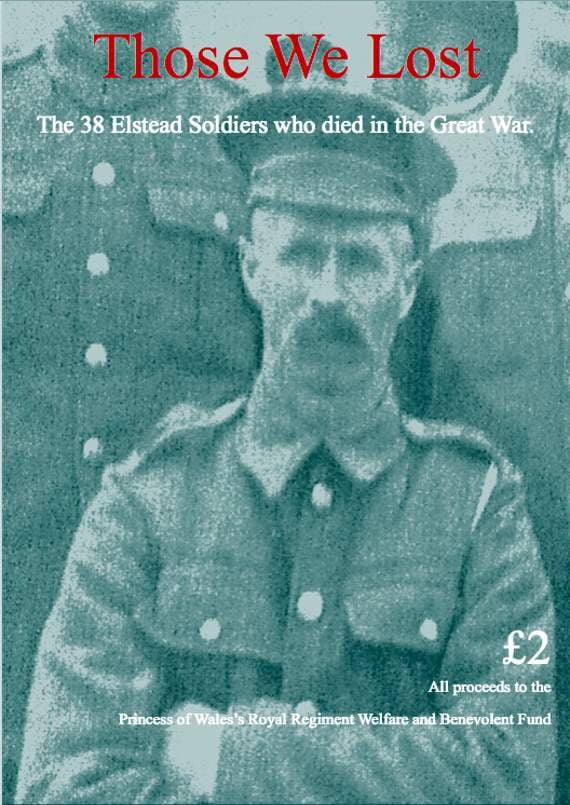
Elstead’s silent soldiers were unveiled at The Mill at Elstead pub on Saturday, June 30, to coincide with Armed Forces Day, during which a booklet detailing the lives of each of the 38 men was also available to purchase in aid of the Princess of Wales’s Royal Regiment Welfare and Benevolent Fund.
.png?width=209&height=140&crop=209:145,smart&quality=75)

This 17-page illustrated booklet, titled ‘Those We Lost’ and written by Kim Spicer, shares many stories of wartime sacrifice, including the tragic case of the Burchett family who lost three sons during the Great War, and their neighbours in Pot Common, the Wisdoms who lost two.
Sergeant Arthur Burchett, born in 1890, was the first Elstead man to fall after just one month in service on September 14, 1914 at the Battle of Aisne. Having signed up with the Coldstream Guards in 1908, he was part of the British Expeditionary Force in France at the outbreak of war, and was awarded the Mons Star.
His brother, private Colin Burchett, was born in 1893 and worked as an under-carter on a local farm before joining the Middlesex Regiment. He died on December 11, 1917, in Flanders, aged 24. Colin rests in the Lebucquiere Communal Cemetery.
The third brother to die, Private Edwin Burchett, was the eldest of the three having been born in 1879, and enlisted with the Wiltshire Regiment. He was the last Elstead man to fall on November 1, 1918, while serving in Egypt, just 10 days before the Armistice was signed. Edwin is buried in the Haifa War Cemetery.
In addition to the Burchett family’s devastating loss, their next door neighbours in Pot Common, the Wisdom family, also lost two brothers, Albert and Walter - meaning the two homes together lost five young men.
Albert Wisdom was born in 1890, enlisting in Guildford on September 7, 1914, at the age of 24 as a private in The Queen’s Regiment, 8th batallion. Albert was one of the six Elstead men who fell at the Battle of Loos, all on the second day on September 26, 1915, and all probably having never fired a single shot in combat.
His brother Walter was born in 1896 and worked as a farm labourer before joining The Queen’s Battalion, 7th Regiment as a private. Walter died in Flanders on April 3, 1916, at the age of 20. Tragically, the Wisdoms’ cousins Lewis and Walter Novell also fell.
Another sad tale detailed in the booklet include that of Alfred Frederick Reffold, a farm labourer who enlisted into The Queen’s Regiment, 2nd Battalion, as a private. Alfred was killed in action at Flanders on October 29, 1914, and is remembered on the Ypres (Menin Gate) Memorial and is buried in Belgium. Alfred was posthumously awarded the 1914 Star, the British War Medal and the Victory Medal.
Meanwhile, another young man profiled, Harold Young, was born on September 22, 1894, in Shalford to Allen Young (1869 to 1957) and Jane Kingston (1869 to 1946), and later lived at 1 Cedar Mount, Hope Street where Harold’s father had his own hand-made broomsquire business.
Harold enlisted into The Queen’s Regiment as a lance corporal and was awarded the Victory Medal and 15 Star Medals. He died on October 4, 1917 at the age of 23 at Broodseinde in Flanders. Harold rests at Zonnebekee in Belgium.
All proceeds of the booklet’s sale will be donated to the Princess of Wales’s Royal Regiment Welfare and Benevolent Fund, in recognition of the fact more than half of Elstead’s fallen men were part of The Queen’s Regiment, a forebear regiment of the Princess of Wales’s Royal Regiment, whose ambassador Lynn Smith-White was present at The Mill.
On July 7, Elstead locals were also invited to a garden party at Bridge House featuring a demonstration of homing pigeons along with an explanation of the wider roles of animals in the First World War. The silent soldiers were again on display and a member of the Military Wives Choir sang traditional wartime songs.
Comments
This article has no comments yet. Be the first to leave a comment.