
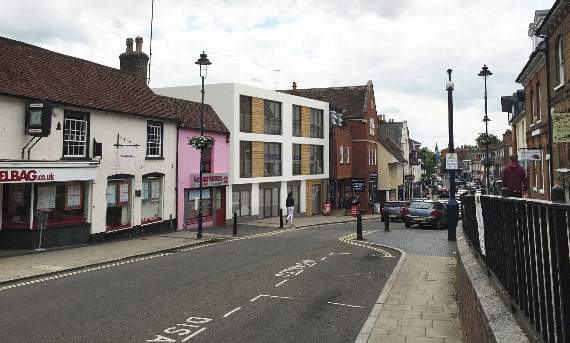
A CONTROVERSIAL proposal to knock down an attractive 18th century building on Alton High Street and replace it with an “ugly retro box” is nothing short of scandalous.
This was the view of many as the application by Hook-based agent Bell Cornwell Chartered Town Planners, on behalf of Andrew Scott, came up before Alton Town Council’s planning committee last Wednesday.
The proposal for 9-11 High Street, currently home to an insurance company, is to demolish the building and replace it with a “modern” three-storey building with A1/A2 use at ground level and seven residential apartments on the two floors above.
But councillors were alarmed by the proposed design, feeling that not only would it destroy the historic street scene but it would create an unacceptable “blot on the landscape” that would significantly and adversely affect the character and appearance of this designated conservation area.



They lodged a strong objection to the application, registering “extreme disappointment” that a proposal of this kind should come forward for such a sensitive site, and one that would constitute “an unacceptable over-development of the site where form, bulk and mass of development would be at variance with that of the immediately adjoining properties which provide the essential character of the area”.
While ready to welcome good contemporary design, in addressing the committee on the issue, Alton Society chairman Bob Booker expressed members’ “astonishment” that the architects should have “ignored so completely the elementary design considerations that should apply within the Alton town centre conservation area”.
New development, said Mr Booker, should show sensitivity and “fit in” with its surroundings, which this definitely would not.
He expressed concern too over the lack of parking spaces associated with the proposed redevelopment and that the size of the flats (six one-bed and one two-bed) was inadequate. “They would seem to be building for dwarfs with no cars. It’s ridiculous,” said Mr Booker.
These sentiments are in accordance with the 39 other letters of objection, lodged with East Hampshire district planners, which refer to the proposal as being “completely out of character” with other buildings in area, likening it to a “carbuncle” in the making, reflecting what many feel to be the worst in design by repeating the mistakes made in the1960s and 1970s and doing nothing to enhance the street scene.
The question is raised over why it would not be possible to retain the facade of the existing building, which is seen to enhance that end of town, sustaining the historic feel of Alton as a small market town.
By contrast, the one registered supporter of the proposal argues against any re-development being another “pseudo building” of no distinction, and one that would “ape the medley of existing building”.
According to historian Jane Hurst, while numbers seven to 11 High Street are not listed, they are of historic value. The site was part of Crown Close until 1741 when it was acquired by Alton bricklayer Anthony Suter “in order that a tenement or dwelling house with other outhouses and edifices might be thereon erected”. Four years later he added the site of numbers three and five and built the present Travelbag premises.
Following numbers seven and nine through various plans and maps, Mrs Hurst has found that they were part of Suter’s original house and, as such, are “an important part of the street scene”.
She said: “The verniculated key stones of the first-floor windows, that can be seen in early postcards, show that Mr Suter was aware of architectural fashion.”
While number 11 enjoyed a chequered history, first as a dwelling and in later years as the home of a gunsmith and bell hanger, a boot and shoemaker, and a carpenter, it was altered and rebuilt in the late 1800s for use as a china depot.
After the Second World War, numbers nine and 11 were amalgamated for Fine Fabrics and the whole shop front altered and tile-hung, presumably to make the street front more coherent, said Mrs Hurst, “a reflection of many Alton buildings which were tile-hung in the past, usually to give protection on the weather side”.
In commenting on the present proposal that numbers nine and 11 High Street “be swept away”, Mrs Hurst said: “It would be a tragedy if part of Anthony Suter’s house of circa 1741 was demolished in order to erect something so out of keeping with the Alton street scene on this part of Crown Hill.
“In the 1960s and 1970s, we lost several good historic buildings which were replaced by premises which are a total eyesore and do not fit in with our market town. It must not be allowed to happen again.”
Comments
This article has no comments yet. Be the first to leave a comment.