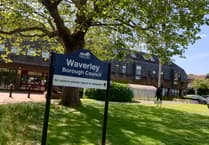
AN angry Herald reader has claimed that Waverley Borough Council's decision to withhold the conditional contract for the East Street development has not been defended by the local authority ombudsman, as the council has suggested. In a letter to The Herald this week, Brian Davey asserts that, in deciding to withhold the contract, the council executive in fact chose to ignore the ombudsman and disadvantage the residents. His claims were in response to a quotation from Waverley's portfolio holder for East Street, Chris Mansell, in a Herald story published last week. Mr Mansell said: "The local authority ombudsman has rejected claims that Waverley Borough Council was wrong in not releasing the full text of the conditional contract." Mr Davey suggested: "If Mr Mansell believes that, then he simply doesn't understand the ombudsman's position and limitations." The issue involves complaints made by residents about Waverley's alleged withholding of information about the conditional contract signed for the East Street development between the council and the developers, Crest Nicholson, in 2003. The council stated that after an exhaustive investigation into the complaints, the ombudsman found that there was no fault in the council's process for addressing the issues. The ombudsman was quoted as saying: "I have concluded that in obtaining and acting on the advice of its solicitor and monitoring officer, and in taking counsel's opinion, the council acted reasonably." Mr Davey said that the ombudsman in fact took legal advice and agreed with the residents that Waverley could not lawfully declare the conditional contract exempt and withhold it from the public. He claims that the ombudsman wrote to Waverley and asked the council to reconsider its position, but that Waverley declined and argued that since officers had taken legal advice and acted on that advice, even if that advice was wrong, the council was not guilty of maladministration. Mr Davey's letter continued: "The ombudsman has no power to make a legal decision - that is the prerogative of the courts. "The ombudsman advised members of the public that they could refer the matter to the High Court by judicial review, where the opinion of the ombudsman would carry great weight. "In the meantime, the ombudsman had no choice but to rule that Waverley had not committed an act of maladministration." Mr Davey went on to say that the ombudsman did not actually reject claims that Waverley was wrong in not releasing the full text of the conditional contract. "Quite the contrary. The ombudsman did all in his power to persuade officers and councillors to behave lawfully and release the contract. "Clearly the executive chose to ignore the ombudsman and disadvantage the residents." Mr Davey adds: "My personal advice for those members of the public who have struggled for nearly two years to have sight of the conditional contract is not to pursue the matter further through the courts. The Freedom of Information (FOI) Act 2000 is a far more powerful weapon." Mr Davey has made an application for a copy of the conditional contract under the FOI Act and said that last Friday he received an assurance from Waverley's Information Rights Officer that he would receive a copy in the coming week. Mr Davey concluded: 'Any interested member of the community is now free to obtain a copy from Waverley Borough Council. There is more than one way to defeat a culture of secrecy." Waverley would give no comment on Mr Davey's claims concerning the view taken by the ombudsman, responded to his letter by saying that the full contract is in fact not yet available to the public. A Waverley spokesman said: "The contract contains confidentiality clauses, so before we can issue any part of it to the public we have to get the permission of all parties involved, and we are currently still in discussion with the other parties as to what information can and cannot be released." She added: "As soon as we have that information, we will reply to Mr Davey's request." Another who has spoken out against Waverley's failure to release the conditional contract is Liberal Democrat prospective parliamentary candidate Simon Cordon. Mr Cordon has said that since the Freedom of Information Act came into force on January 1, the council had an obligation to release certain information within 20 days of a written request by a member of the public. Prior to January 1, Mr Cordon submitted requests to see all contracts and legal agreements between Waverley and the developers of the East Street regeneration and a Godalming key site. Twenty working days after his request, Mr Cordon received an e-mail from Waverley explaining the information was not yet available but would be dispatched in the next few days. Mr Cordon said: "This doesn't bode well. I expect Waverley may have just covered itself within the act by sending the e-mail to me, but it doesn't change the fact that they have failed to meet the request in the statutory time." He added: "Even if there is some hitch with one or other of the developers, Waverley should have provided me with anything it has itself, even if this were only some of the documents." A Waverley spokesman said: "Waverley has received a number of requests for information relating to the contracts for East Street and the Godalming key site. "There are circumstances where the 20-day deadline for providing the information can be extended. It may be that some of the information requested will fall within the exemption provisions. "The contracts also contain confidential clauses and before Waverley can issue any part of the contracts, permission must be given by all parties. "We are currently waiting to hear from contractors in respect of the requests received to date. When we know the position, we will be able to respond in full." She added: "Waverley is satisfied that it has and is continuing to use its best endeavours to respond fully to Mr Cordon's request, as will be evident to the Information Commissioner in the event of a complaint being made to him."
.png?width=209&height=140&crop=209:145,smart&quality=75)