
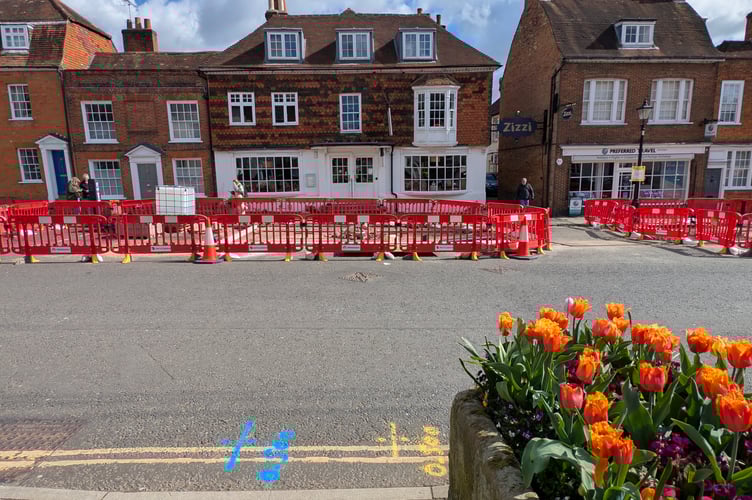
The audit was carried out on an earlier design, which has since been abandoned. There is no clear evidence that the revised layout properly considers cyclists, despite the junction of Castle Street and Park Row forming part of the Scholars Greenway, a route intended for schoolchildren and parents, and part of the national cycle route King Alfred’s Way.
Large numbers of cyclists unfamiliar with Farnham use King Alfred’s Way each year, so safety is paramount where the route meets the town centre. The overall objectives of the FIP stated it would “make walking and cycling the most natural choice for shorter journeys”, reducing traffic and pollution. It was therefore reasonable to expect the £17 million scheme would provide a safe crossing point, but the current plans do not appear to do so.
The latest designs do not include a zebra or signalised crossing on this busy A-road, where vehicles often travel downhill at speed. Instead, they include a ‘raised table’ crossing linking Long Garden Walk to the Giggling Squid restaurant. While this may improve accessibility, it risks creating a new hazard.




Cyclists travelling east along the Scholars Greenway are likely to continue on this level surface to cross Castle Street. But on reaching the east side, they are left with no safe way to continue towards Park Row other than by cycling on the pavement.
Cycling on the pavement is illegal, so introducing a raised table without a short connecting cycle route risks encouraging behaviour that could reduce pedestrian safety. The design may increase conflict between pedestrians and cyclists rather than improve conditions for both.
Concerns are not theoretical. In recent weeks, drivers have ignored No Entry signs at Castle Street and Park Row to avoid diversions during the Borough closure. The removal of the ‘except for cycles’ sign near the Nelson Arms—replaced with a ‘Traffic Enforcement Cameras’ sign—has added to confusion.
The original sign made clear that Park Row remains two-way for cyclists, despite being one-way for motor vehicles. Its removal has led to more frequent confrontations between drivers and cyclists travelling in opposite directions. Surrey Highways has confirmed the sign will be reinstated, but the episode highlights how small design decisions can have immediate safety consequences.
If the Farnham Infrastructure Programme is to meet its aim of prioritising walking and cycling, these issues need to be addressed before construction is complete. Otherwise, there is a real risk the scheme could create confusion, conflict and reduced safety at a key town centre junction.
*In response to these claims a spokesperson for Surrey County Council said Castle Street “has been subjected to a comprehensive Road Safety Audit in line with national GG119 standards” and is designed to operate within a 20mph speed limit. They added that “the safety of both pedestrians and cyclists has been considered and assessed at every stage”.
Comments
This article has no comments yet. Be the first to leave a comment.