
LEVELS of air pollution have increased at more than two thirds of monitoring locations in Farnham - and remain illegally high at a dozen pollution hotspots across the town.
Waverley Borough Council published its long-awaited 2016 Air Quality Annual Status Report last Friday, revealing an overall improvement in air quality across the borough as a whole.
But the latest figures for Farnham tell a different story - showing the annual mean levels of hazardous nitrogen dioxide (NO2) have increased at 13 of 19 (68 per cent) monitoring locations in the town.
Of these, NO2 levels still exceed the national annual mean objective of 40 micrograms per cubic metre (µg/m3) in The Borough, the Downing St/West St junction, East St, the Royal Deer crossroads, Farnborough Road, Wrecclesham Road and Station Hill.



Waverley claims that after ‘local bias’ is taken into account, just three locations - two in The Borough between Castle Street and the Royal Deer crossroads and Wrecclesham Road just north of the railway bridge - breached the legal limit in 2015.
However, for the first time the council has admitted that it lacks the necessary equipment to monitor for the smallest particulate matter ‘PM2.5’ and as such Farnham’s air pollution issues may be even worse than feared.
Air pollution is associated with a number of adverse health impacts - and NO2, which is emitted by diesel cars, is thought to pose the greatest risk to health.
It is linked to the development of respiratory disease, as well as cardiac, vascular and kidney diseases, and strokes, and particularly affects the most vulnerable in society: children and older people.
Up to 40,000 people are thought to die prematurely each year from the effects of air pollution in the UK, and the annual health cost to society of the impacts of particulate matter alone is estimated to be around £16 billion.
Waverley was duty-bound to declare three Air Quality Management Areas (AQMAs) in 2004 - in Farnham, Godalming and Hindhead - after excessive levels of NO2 were first detected.
In Farnham, the council blames the pollution on congestion in the town centre and specifically the “poor dispersion of pollutants where roads narrow with tall buildings on either side”.
Waverley first developed a borough-wide Air Quality Action Plan (AQAP) in 2008 to tackle the issue.
But in its 2016 status report, the council admits any action so far has been limited to “small measures” such as securing electric vehicle charging points through the planning process and “enhanced enforcement of parking and loading restrictions”.
Waverley has previously hinted at more ambitious schemes, such as banning HGVs (vetoed by Surrey Police) and diesel cars from the town centre, and MP Jeremy Hunt and Surrey County Council have proposed remodelling the town centre road network.
However, the council’s report adds the “biggest challenge facing Waverley are the financial implications of long-term options”, and it estimates the “conservative costs” of remodelling the town centre at a prohibitive £3 million.
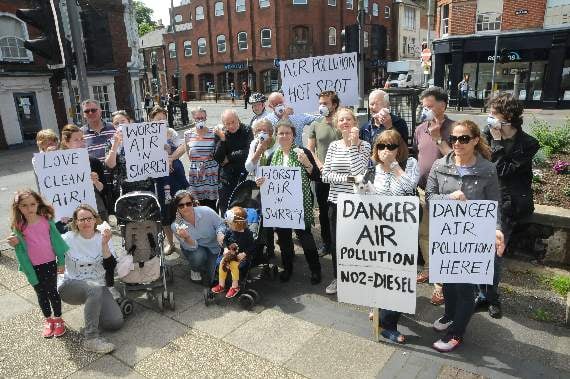
Farnham’s air quality has become a hot topic in the build-up to the general election on June 8, and on Monday supporters of National Health Action candidate Dr Louise Irvine gathered at the Royal Deer crossroads to protest against the Conservatives’ handling of the problem (see pictured right).
Speaking to The Herald, Dr Irvine expressed her belief that a new transport system in the town centre may present a solution to Farnham’s air quality issues, but criticised the town’s Tory MP since 2005 Jeremy for his perceived inaction over the past decade.
She said: “Jeremy Hunt has failed as Health Secretary and he is failing to protect the health of families in Farnham. He promised to look into this problem in 2005 when he first became the MP for the area: 12 years later and the town is still waiting to see change.
“He is no closer to suggesting a viable solution and the Conservative government has washed its hands of the problem of air pollution too.”
Lib Dem candidate Ollie Purkiss has also criticised the Tories for failing to tackle the issue after more than a decade of monitoring.
Mr Purkiss said: “12 years after the dangerous pollution hotspots were identified in Farnham and Godalming little has been done to improve them. This latest report shows the diligent monitoring that happens, but action to improve matters is still not happening all these years later.
“The Lib Dems are offering plans for a national focus on air quality, and have the experience locally to deliver on those plans. Only by working together nationally and locally can we tackle this deadly problem.”
Responding in turn to Waverley’s report, Mr Hunt said: “The results from Waverley’s air pollution report are disappointing especially for Farnham.
“This is why I am saying it is time for action on the part-pedestrianisation and traffic reducing initiatives I have been pushing for since Farnham voted to solve the problem in a referendum and hope we can have a public consultation on a possible scheme later this year.
“If Godalming and Guildford can solve these problems so can we! I want Farnham to be the most beautiful town centre in the South East, a pleasant place it is easy to walk through with children and enjoy our many wonderful shops and cafes.
“It’s always easy to knock any changes, but rather than picking holes, the critics should swing behind what is planned and show Farnham is united in wanting to sort this problem out.”
Waverley’s 2016 Air Quality Annual Status Report will go before the council’s executive committee on June 6.
Comments
This article has no comments yet. Be the first to leave a comment.