
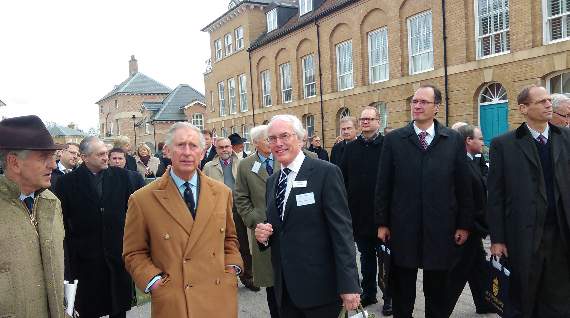
REPRESENTATIVES from East Hampshire District Council joined the Prince of Wales at a reception to display the achievements of the Poundbury development in Dorset.
Ferris Cowper, the leader of the district council, and Steve Pearce, the Whitehill and Bordon regeneration project director, were invited to join a tour and presentation on the development and to meet Prince Charles at a reception on November 23.
During a two-hour visit to the development in Poundbury, which has been built on Duchy of Cornwall land according to principles advocated by The Prince of Wales, there was a tour of the site where the East Hampshire representatives discussed the principles used with Charles.




The council was told about the work of The Prince’s Foundation which demonstrates “sustainable development” and places “community engagement” at its heart.
The Prince of Wales has been keenly interested in the quality of both the natural and built environments and, in the 1989 book A Vision of Britain, he set out his beliefs on the principles of architecture and urban planning.
Principles that the two developments share include a focus on varied architecture that reflects the heritage of the area, emphasising a “strong sense of local community”, and “high quality public services and amenities”.
In addition, both schemes attach great importance to the provision of residential, employment and commercial premises in a layout which allows residents to work, rest and play locally to reduce car use.
Poundbury gives priority to people, rather than cars, and commercial buildings are mixed with residential areas, leisure facilities and shops to create a “vibrant” and “walkable” community – and East Hampshire District Council hopes to see this echoed in Whitehill and Bordon.
“It’s a great honour for us, as representatives of the district council and the town, to have had the opportunity to visit Poundbury and to learn about The Prince of Wales’ development,” Mr Cowper said.
“It was wonderful to meet with His Royal Highness and to hear his views on sustainable developments.”
Comments
This article has no comments yet. Be the first to leave a comment.