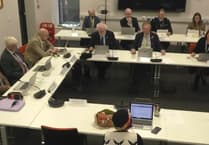
STAGGERING domestic violence figures have served to highlight the invaluable work of East Hampshire Victim Support (EHVS). Current statistics reveal that every week two women are killed by their current or former partner in the UK and that on average a woman will be assaulted by her partner or ex- partner 35 times before reporting it to the police. Figures also show an estimated 19,910 women and 28,520 children stayed in refuges in England in the year ending March 31, 1998, and that domestic violence accounts for one tenth of all violent crime. According to EHVS co-ordinator Lucy Morgan, in East Hampshire last year (January to December 2003) her team supported 130 victims of domestic violence and this year, to date, that figure has risen to 212. That may be because more people are seeking support and/or are aware of the service. "This sort of crime is always there but it seems more people this year have felt able to ask for our help," said Mrs Morgan. Whatever the reason for the increase, Victim Support has earned itself a reputation for being the "hidden service" - helping to pick up the pieces of people's lives after a crime has been committed by offering support to help them deal with the trauma, to re-establish confidence and get back on track. During her address to the November meeting of East Hampshire District Council's NW community committee, Mrs Morgan told councillors: "We work very closely with the police, but it is a one-way relationship - they tell us loads and we tell them nothing." Lucy Morgan said that in East Hampshire last year Victim Support supported more than 1,600 people - of these less than half were referred by the police. In fact figures reveal that just 41 per cent of all crime in the district is reported to the police and of these only a very small percentage will actually come to court. The other 59 per cent of crime goes unreported for a number of reasons: because it is felt by the victim(s) to be too trivial and that the police will not be interested; because people are unaware that a crime has been committed - for example in the case of bogus tradesmen; or because it is a personal crime, such as violence in the home (which can be against men or women) but about which people may feel unable to talk. "We would like to think that we are reaching out to support those who have yet to pick up the phone and call the police," said Mrs Morgan. "We all react to life in our own way but when crime happens to us we lose control for a moment - some are able to cope but others can feel despair - coping skills can depend on other things and it may be the last straw. "We are not counsellors but we can offer emotional and practical help and information. And we let people know that it's OK to be angry, to feel threatened and abused. It is about learning to cope - sometimes it is sufficient to know that somebody else cares but others may need ongoing support which could stretch into years." Based at the probation office above Alton Magistrates' Court, EHVS enlists the support of 16 committed volunteers whose job it is to support and advise victims of crime. The venue is not ideal and Lucy Morgan would very much like to be able to offer "drop-in" facilities, perhaps in the future as part of a new community centre set up. Nor does she wish to raise alarm over the apparent magnitude of the job which, compared to other parts of the country is relatively insignificant. "In this area fear of crime is still a greater problem than crime itself. Nonetheless, when you ask people individually if they feel safe living here, the answer is still 'yes' . "For our part we want to let people know that we are here if they need our help but we are keen also to continue to promote East Hampshire as a secure, happy and safe place to live."