
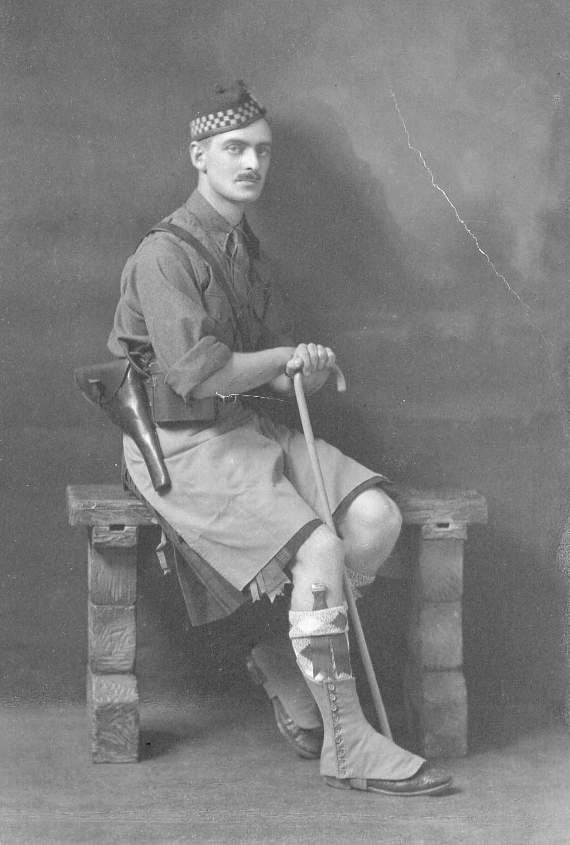
THE papers of a Somme tank commander who married his sweetheart in Farnham before fighting on the Western Front have been published for the first time by the National Army Museum.
Major Allen Holford-Walker, originally from Essex, married Joan Barrington Moody in Farnham soon after the outbreak of war in 1914.
As a tank commander on the Somme, serving with The Argyll and Sutherland Highlanders in honour of his mother’s Scottish heritage, he later fought in both the Battle of Flers-Courcelette and the Battle of Ancre in late 1916.
His papers, which include photos, diaries and letters, give a first-hand account of the earliest days of tank warfare, as the British struggled to make the most of their new weapon.



The development of the tank had been a closely guarded secret as the British Army tried to find a mechanical solution to trench warfare.
Both Allen and his brother. Archie. commanded tanks on their arrival on the Somme at the Battle of Flers and found them to be very unreliable. Of the three tanks under Archie’s command, one broke down, one suffered damage and one ran out of petrol and needed re-fuelling by the brothers.
When the attack started, only 15 of the 49 tanks available were able to move into no-man’s-land. In Allen’s post-war assessment of the attack, he wrote that the element of surprise had been wasted, and that the tank crews had been thrown into battle without adequate training.
In September 1916, artillery and infantry were working together, with troops advancing behind the creeping barrage. But at Flers large gaps were left in the bombardment and in other battles infantry overtook the slow moving tanks and found themselves trapped in heavy machine gun fire, suffering heavy losses.
At Ancre it was decided that tanks would follow the infantry. As Allen’s papers show, it was emphasised in instructions to troops that “the infantry would not wait for the tanks”. This meant that the tanks would instead be used to mop up after the infantry but the machines themselves were slow, cumbersome and prone to technical problems.
In the glutinous November Somme mud, they were vulnerable to getting stuck, which Allen records as fateful: “I attribute the fact of the tanks failing to gain their objective to the extraordinary bad ground they had to cross which was worse than I imagined possible.”
The new tanks and their inexperienced crews were ultimately ineffective at Ancre.
A breakthrough was very nearly achieved with the ground-breaking vehicles at the Battle of Cambrai in November 1917, where tanks were first used on a mass scale.
However, by 1918 the tank ensured final Allied victory as it became part of a complex all arms battle-plan, combined with aircraft, artillery and infantry tactics.
Dr Peter Johnson, collections development and review manager at the National Army Museum, said: “Major Allen Holford-Walker’s papers demonstrate how the British were forced to develop a whole new set of battle tactics for the newly-invented tank.
“The British Army were under great pressure to adapt and innovate a way to break the bloody stalemate of trench warfare on the Western Front. It was the lessons learned on the battlefield by soldiers like Allen Holford-Walker, often at great cost, that paved the way for later Allied victories in 1918.”
After the Battle of Ancre, Major Holford-Walker returned to England and was awarded the Military Cross in the New Year’s Honours of 1917 for his bravery in France.
He was on sick leave when the war ended on November 11, 1918, and celebrated the Armistice with his wife Joan in Dorset. His two brothers also survived the war, despite suffering injuries.
Allen and Joan had three children together and in 1929 the couple bought a farm in Kenya, where they raised Ayrshire cattle and owned a pet cheetah named Pong.
He briefly returned to England during the Second World War. Being too old to fight he was made an honorary Colonel and was commanding officer in the driving and maintenance school at Bovington, Dorset. He also advised at the Colonial Office and led passive air defence in Scotland.
Major Holford-Walker died at his home in Nanyuki on April 22, 1949.
One hundred years after the first tanks arrived on the Somme, Allen’s grandson has served with the Royal Hussars and his great-grandson serves with the Royal Armoured Corps in Bovington, Dorset.
Comments
This article has no comments yet. Be the first to leave a comment.