
In the September 29 edition of the Herald, I introduced the concept of a scheme to improve the Hickleys Corner junction on the Farnham bypass that included an upgrade to Station Hill and the station area, writes Farnham Residents town and borough councillor and former Farnham Town Council leader, John Neale.
The scheme is called Firgrove Hill Interchange since it incorporates a full interchange between the A31 bypass and the A287 Firgrove Hill.
My thanks to Herald readers who have come back to me over the past month expressing support for this option.
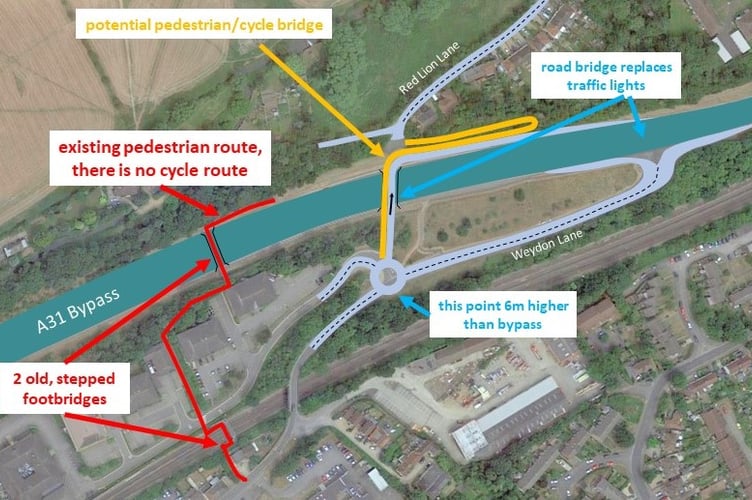
This week I want to show you another scheme, this time relating to the junction of Weydon Lane on the bypass.
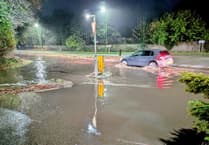

This junction, just west of the Firgrove Hill bridge, is currently controlled by traffic lights. We call it the Weydon Lane Interchange, for sake of argument.
Both of these schemes are intended to support two objectives:
- Satisfy the highways authority’s desire to improve traffic flow on the bypass.
- Provide much-improved connectivity for vehicles, cyclists and pedestrians across the bypass.
The bypass, today, presents formidable and, arguably, unsafe crossings for our residents.
Weydon Lane Interchange
This scheme is intended to provide a new, safe, active travel route between the town centre and the Weydon/Shortheath areas, making it easier and safer to cross the bypass.
Many people ‘take a run’ to cross the road at the moment – not a good option on this fast-moving road. The scheme could provide a real incentive for children to walk or cycle to school.
Fortunately, the land at the entrance to the Farnham Business Park is much higher than the A31 so, from there, a bridge could span the bypass, with a ramp on the northern side.
The bridge would contain a cycleway and a one-way vehicle carriageway to the northern side.
Red Lion Lane would remain as a closed road with no connection to the new bridge.
This arrangement would allow the traffic lights at the Weydon Lane junction to be removed, thus improving the bypass traffic flow.
Traffic approaching the junction from the Coxbridge roundabout, wishing to turn into Weydon Lane, would be signposted to use Wrecclesham Road instead, or it could double back from the Firgrove Hill Interchange, if this was also built.
The existing stepped footbridges across the bypass and the railway, neither of which are appealing to pedestrians, would become redundant.
What does this do for Farnham?
As a councillor, it is not my role to design highways. However, it is part of my role to put forward ideas from the public to the council’s highways team, hopefully presenting the local experience and technical expertise that exists in our community.
These two schemes have come from the community and are seen as credible by local civil engineers. They are just two examples for us all to consider. It is now up to the programme team at Surrey, who are aware of the ideas, to decide whether they are technically feasible options and to consider them alongside any others they have outlined.
It would appear to me both schemes provide what local people want, which is improved connectivity across the bypass and ways to encourage more walking and cycling in Farnham.
The schemes should also provide the A31 highway improvements that Surrey is looking for, and active travel benefits that will help to leverage government funding.
If you have any comments on either of the two schemes, or want to see a reprint of the earlier article, please contact me by email to [email protected] and I will ensure any responses are forwarded to the Infrastructure Programme team.
Comments
This article has no comments yet. Be the first to leave a comment.