
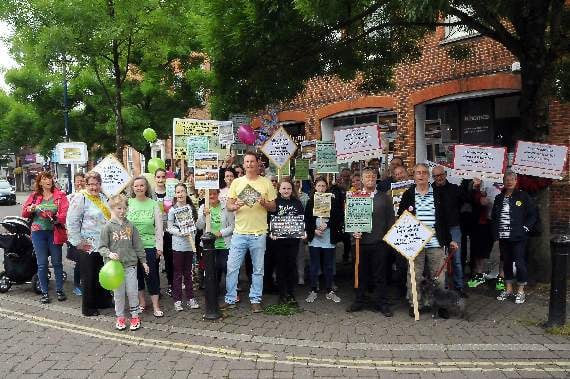
PRESERVE Treloar Meadows campaigners were out in force on Saturday with banners held high, urging the public to support their cause.
In a peaceful but lively cross-party demonstration, televised by BBC South, their message was clear - they want East Hampshire District Council (EHDC) planners to carry out a proper environmental impact assessment as part of the reserve matters application for a 280-home development on part of the former Lord Mayor Treloar Hospital site that threatens to destroy the delicate ecology of the meadows.
With the online petition now exceeding 1,400 signatures, site developer Crest Nicholson can expect some lively questioning at its public consultation, which takes place next Tuesday (June 5) at Alton Assembly Rooms, from 3pm-8pm.
Also featuring on the BBC South TV coverage was district biologist Dr June Chatfield, who believes it is time to move on from the public campaign and to approach the problem scientifically by raising understanding, in the wider context, of the impact development will have on the delicately-balanced ecology of what is a “very important” and inter-connected eco-system between valuable low-nutrient grassland and its ancient woodland surrounds.



And of the apparently misguided intention to turn the meadow into a country park with its human connotations which, Dr Chatfield believes, will be equally destructive to the natural environment.
Dr Chatfield was captured on camera at the weekend using an entomologist’s sweep net to entrap and record a wide range of invertebrates in the grassland sward of the Treloar Meadows site which, alongside more than 40 plant species in the flower-rich meadow - from ox-eye daisies and meadow buttercups to the common spotted and pyramidal orchids, go to make up the biodiversity of a thriving eco-system that needs to be kept in good condition, and not treated as a mown play area.
“Support your eco-system, it supports you” was the message in European Conservation Year in the early 1970s and it is a mantra in which Dr Chatfield holds a firm belief.
She believes planners are looking at the human side of development first, rather than the soil beneath, and that by the time the geology of the site is considered, at the reserve matters stage, it is often too late, with too much money spent for things to change.
She said: “Alton is suffering from heavy pressure from central Government to find room for large housing schemes, with the extension of Treloar Heights one of several on our perimeter. The more I get involved in these the more I am aware of the need for planning reform as reserved matters application is too late for successful handling of environmental factors.
“As the first step one needs to make a thorough appraisal of the ground rock geology that determines drainage, topography, past land use, as well as the natural flora and fauna and the whole eco-system. One large, numerous and destructive mammal, homo sapiens, is the cause of many problems and not being so smart as its species name might infer.”
Dr Chatfield believes that to break down valuable eco-systems is the road to self-destruction - a warning based on experience.
“Trashing of the countryside by overproduction and development happened earlier in the United States and in the mid-1970s, when I was in Michigan, there were environmental impact surveys going on long before they came into European law and something we need to endorse here after Brexit under our own legislation.
“The mind-set of the interconnectedness of all parts of the environment or eco-system is important and learning to be modest and not greedy helps to prevent breakdown of eco-systems that we depend on for our own existence.”
Comments
This article has no comments yet. Be the first to leave a comment.