
A FARNHAM woman's struggle to clear her grandfather's name took a significant step this week following a potentially historical ruling at the Royal Court of Justice.
Janet Booth, 63, of Alma Way, Heath End, and her husband were present to hear the judgement after representing her now deceased grandmother, and her mother, Gertrude Harris.
The family have been campaigning for the past 13 years to gain a posthumous pardon for Private Harry Farr, following his execution for "cowardice" by firing squad in 1916. At Monday's hearing, Justice Stanley Burnton declared that the family lacked legal grounds to contest a decision made last year by Geoff Hoon which declined a posthumous pardon. Nevertheless, he declared there was "room for argument" that both Mrs Harris and Mrs Booth had been incorrectly denied a conditional pardon, suggesting that military authorities should not have imposed the death penalty in the circumstances.
"The point is a short one but it seems to me a point which is worthy of decision by the court," he declared.
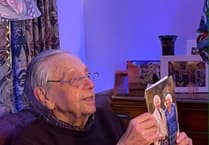



"Monday was a ray of hope, we were very pleased with the result," remarked Mrs Booth after the hearing.
"We're in the hands of the solicitors and lawyers who are doing well on our behalf. We believe he was innocent, and my grandmother certainly felt he was innocent." she said. The story of Private Harry Farr is a tragic one.
"He was a regular soldier from 1908 and was recalled in 1914 to go to war. He went out to France with the expeditionary forces, so he wasn't one of Kitchener's men – he was a regular soldier," said Mrs Booth.
Aged 25, he was sent for court martial in October 1916 for "misbehaving before the enemy in such a manner as to show cowardice". Yet Pte Farr had previously spent five months in hospital, and suffered with "shell-shock" – post traumatic stress in the parlance of our times – on his return to the front line.
"It was a short trial – his medical condition was not taken in and he defended himself. You were allowed to have a 'best friend' defend you, but there were so many deaths then, that 'best friends' must have changed rather frequently," remarked Mrs Booth. Pte Farr was sentenced to death at 6 am on October 18, by firing squad, at Carnoy, near The Somme. His death was recorded as "instantaneous".
"When he was executed the Chaplain reported that he refused a blindfold and stood facing the firing squad, who of course would have come from his own regiment. "It seems so unfair but that was the way then," she added.
"My grandfather's five brothers and his father went to war also, and as he was shot as a coward, they didn't even talk about him at home – he was virtually erased.
His name has not been added to books of remembrance and memorials, so there is a dreadful stigma attached."
Following the release of documents in 1991 which stated that no evidence had been provided at the court martial of Pte Farr's medical history, the family have campaigned for justice since 1993.
A campaign by Labour backbencher Andrew MacKinlay, and attempts by Shot at Dawn – a group formed to get pardons for British and Commonwealth soldiers executed during the war – to gain a pardon have thus far fallen on deaf ears.
Mrs Booth and her mother petitioned the Queen in 2003, only to be told by the then Defence Secretary Geoff Hoon it was "unreasonable, flawed and wrong in law". No date is set for Mrs Harris' full hearing, but Mrs Booth is keen to settle the matter.
"We will wait for new date and go back and try for conditional parole – my mother is 91 and we would like to get it sorted before too long." she said.
"It would be history in the making – other countries make pardons, so why we can't, I don't know."