
A BATTLE to re-open a popular High street shortcut, barred to pedestrians with a six feet-high steel fence, won a resounding victory last Friday when Waverley Local Committee voted unanimously to make it a public right of way.
But the war may not be over yet. The landowners who closed the alleyway that leads down beside Lloyds Bank from College Hill to Haslemere’s High Street, in a shock move in February, have six weeks to decide whether to go to appeal.
Determined to get the popular shortcut restored, residents protested it was not only a long-established public right of way but also a safer route for pedestrians.
The situation was complicated, however, because it transpired that although the path had been used for many decades, it had not been registered as a public right of way and so its obstruction was not illegal.


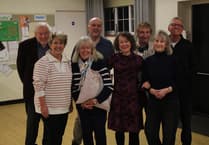
Taking up the cudgels, Haslemere Society chairman Robert Serman made an application to Surrey County Council, in March, for a map modification order to add the alleyway as an official footpath, supported by sworn statements from 64 people, who said they had used the route between 1968 and 2015.
The landowners – local property developers Peter Warner and Hamish Robbie – objected the notices on site provided sufficient evidence to dismiss claims it was a public right of way.
The site includes land formerly used by Lloyds Bank as a private car park that could also be used by customers, which was accessed from College Hill by the same main entrance leading to the alleyway.
The landowners claimed notices erected to say it was a private car park made it clear the alleyway was also private property.
They also sealed off access to Lloyds Bank car park with the steel barrier installed in February.
County council officers disagreed pedestrians would think private car park signs meant the path was not a public right of way and recommended Waverley Local Committee members should approve the application.
They considered the evidence submitted was sufficient to establish public footpath rights and the landowners had not done enough to demonstrate their lack of intention to dedicate public footpath rights during the relevant claim period of 20 years.
Mr Serman and five regular path users, who had sent in supporting affidavits, spoke out in the public slot at last week’s meeting to urge committee members to support their officers recommendation.
Lloyds Bank manager Robert Manville, who ran the Haslemere branch between 1969 and 1984, said: “It is irrefutable the path has been in use for 45 years up until the time the barrier was erected.
“I never instructed anyone to close the entrance and there was no gap that could be closed and locked.
“There was no barrier until this new barrier.”
Many claimants supporting the application said it was a safer alternative.
Although officers said safety issues were not a consideration, Surrey’s highways area team manager John Hilder commented: “Using College Hill as the alternative route, pedestrians are likely to cross the road at the junction with the High Street to use the narrow footway on the western side, then cross it again at the bend where this footway ends.
“Some may elect to walk in the carriageway on the eastern side of the road instead.
“So there is potential conflict with vehicles, where there is none using the alleyway.”
Sue Farley, who ran a nursery school on College Hill from 1970 until 1994, stated she used the path all the time as a safer route into town.
She said:“We had to walk our 70 children and staff to the coach parked alongside the town hall using the footpath by Lloyds Bank car park, as without pavements on College Hill on the bend of the road, this was the safest way to the coach.”
Objecting to the application, Mr Robbie said: “We are only here to decide if anyone seeing the signs could reasonably be expected to understand the land is private.
“These signs date back at least to the 1980s. Private property means private property.
“We strongly assert ‘private’ has one meaning and one meaning only.”
Responding to Mr Robbie, Mr Serman told the committee the rent charged for car park use was originally a nominal £1 a year.
“When these two individuals bought the land I am told by Lloyds property advisers that the charge was increased to £120,000 and they were not prepared to pay that,” he said.
“There are four signs. None visible to users of the path coming from the High Street. All the signs obviously relate to the car park because they are seen by drivers entering the car park site.”
Speaking after the meeting, Mr Serman told The Herald: “This is obviously a very successful outcome and we wait with interest to see if Mr Robbie and Mr Warner will give in gracefully.”
The Herald asked Mr Warner if he would go to appeal but he declined to comment.
Comments
This article has no comments yet. Be the first to leave a comment.