
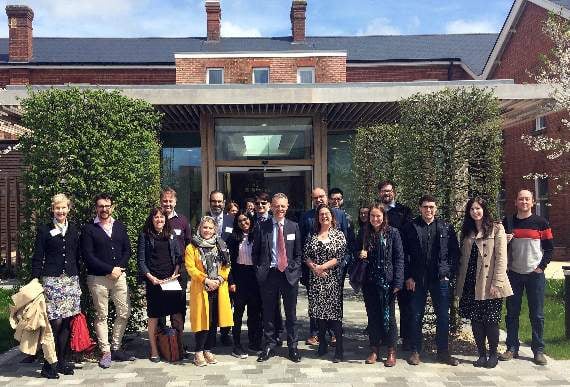
East Hampshire District Council welcomed members of the Town and Country Planning Association’s New Communities Group recently, who visited the town to see the success of the project so far.
The New Communities Group is made up of 20 councils from across the country which are all providing, what the district council describes as, “innovative local leadership” to deliver large-scale developments, with plans for at least 178,000 new homes between them. The group collectively helps to develop plans, provide political support and encourage the sharing of knowledge and best practice through seminars, workshops, ministerial meetings and more.
The district council, a group member, is “leading the way” with the regeneration of Whitehill and Bordon as “one of the most innovative and fastest-growing new communities within the group”.




In a statement, the council praised the project’s recent progress: “After such a successful 2017, the town’s transformation has surpassed all the council’s targets, with more than 220 new homes built; more employment opportunities; more facilities for the community to enjoy; a new major relief road near completion, as well as plans for a new leisure centre and town centre with a cinema, restaurants, a supermarket, shops, businesses and homes.”
The council explained that it was “particularly leading the way” in terms of being one of 10 NHS England Healthy New Towns.
During the visit, on Thursday, April 26, members of the council’s regeneration team also attended a Town and Country Planning Association workshop with Healthy New Town partners to decide what should go in the NHS England Healthy New Town Built Environment guidance publication - a document which outlines what it takes to become one of these communities.
“We are extremely proud to be able to show off the development of Whitehill and Bordon to other councils from across the country,” Ferris Cowper, the district council’s portfolio holder for Whitehill and Bordon, said.
“It is so rewarding to see that all the hard work and innovative ideas are coming to fruition and not only benefiting the residents of the town, but also the whole country as other councils take notes and use the ideas in other areas.
“We owe a huge amount of our success to the New Communities Group as we have also learnt a lot from them and it is extremely useful to be in the same group as other ambitious and like-minded councils which are in the same boat as us and delivering a large-scale project to improve the lives of those who live in their areas.”
But for some residents, Bordon is not considered a beacon of excellence.
Rather, it is still suffering from a lack of facilities, infrastructure and the tangible benefits of major development.
Certain examples are often cited - no rail link, a perception of poor public transport, no high-street banks, and residents often venturing elsewhere for entertainment, shopping and more. Recently, the Hampshire Hospitals NHS Foundation Trust was said to be exploring options after raising concerns that its clinics at the Chase Community Hospital were under used, with some earmarked for relocation to Alton.
The sense that Bordon is somehow downtrodden when compared to neighbouring Alton and Petersfield may well take decades, not years, to address.
“Local people who want better facilities and infrastructure and local jobs should start to get involved because decisions will be made without discussion,” resident Nick Holden wrote on social media.
“Unfortunately Bordon has been promised much over the years and the goal posts will keep changing if not challenged. Population will increase greatly in the next few years and there is nothing I have seen and heard that gives me confidence that we will get anything better.”
Responding, Sheila Innes said: “We are still being treated as the poor relation”.
Having lived in the town for almost 30 years, she felt it had “always been treated poorly” and now, with thousands of “extra houses being foisted on us”, she said: “Nothing seems to have changed. None of the promised improvements are coming, with the exception of the ring road.”
“Rome wasn’t built in a day” might be the response from enthusiastic developers and the district council, but convincing the most sceptical residents might require just a little more work.
Comments
This article has no comments yet. Be the first to leave a comment.