
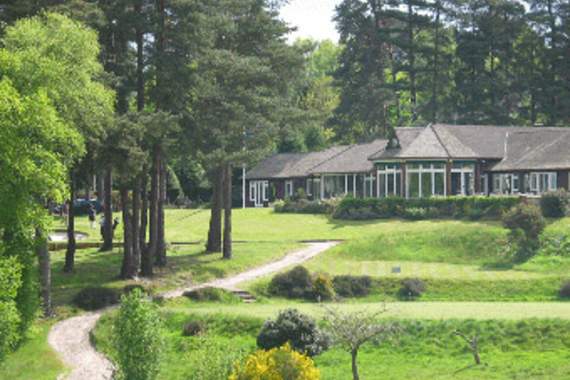
LIPHOOK Golf Club has made plans to remodel a section of its golf course and is preparing to make an application to the South Downs National Park Authority to receive the required planning permission.
The idea for the course re-orientation was originally generated by a need to resolve a critical safety issue associated with the Portsmouth Road (B2070) pedestrian crossing under the railway bridge, which separates parts of the course.
In June 2009, the club’s managing secretary John Douglass was involved in a collision as he crossed the road under the railway bridge in a buggy during a club championship.
He was left hospitalised for several months and spent time in intensive care after sustaining head and shoulder injuries in the smash.




Following lengthy discussion with both the Highways and railway authorities, after traffic calming and road re-alignment studies were carried out, along with consultations with East Hampshire District Council representataives, it was determined an underpass was the most appropriate solution.
A separate pre-planning application for an underpass has already had provisional South Downs National Park Authority and highways approval earlier this year, which will support the planned course changes.
The proposed area for the course remodelling includes habitat and landscape enhancement covering 18 hectares around three fairways on the first right-hand part of the course, before the railway bridge, going south on the Portsmouth Road.
Club captain Jillian Howarth told The Herald: “Current design work has confirmed no net loss in valued ecological habitats would occur from these proposals, and, in fact, there would be a 15 per cent gain in valuable habitats from the course reconfiguration.
“Further, there will be subsequent opportunities for more significant heathland restoration in the 1.45 hectares of current playing areas that become redundant after the remodelling is carried out. The proposals will create new areas of wet heath, wetland and open water – habitats of limited availability in the locality – and acid grassland together with dry heath.
“These fully complement the local landscape character and features associated with this part of the national park.
She added: “The proposals would be delivered through a low key and low impact construction approach typical of operational golf course management.
“All works would be based on re-use of existing soils and vegetation on site, together with some additional planting and limited use of growing media brought to the site for new greens and tees.
“There would be a requirement for limited use of mechanical plant, excavators and dumpers to reshape the new fairways and greens, involving moving native soils, digging tree pits, and relocating heather turf.
“The course management team at Liphook Golf Club is highly experienced, having worked under the HLS agreement for several years to the satisfaction of Natural England.
“Golf club staff will be working alongside a specialist golf course contractor with experience of heathland translocation, under the management of the golf course architect and the course manager.”
The 18-hole heathland course covers more than 80 hectares overall and has fairways lined with areas of grassland, heather, gorse and trees. The area includes the clubhouse, golf club facilities, railway line, a section of the old A3 Portsmouth Road and associated lanes, and is adjacent to the Wheatsheaf Enclosure.
Existing access for cars to the site is already in place via the Portsmouth Road and the entire scheme is aimed to comply with the national policy framework, the East Hampshire District Council’s local plan as well as policies emerging from the South Downs National Park Authority.
The course is characterised by its heathland landscape, framed by woodland. Natural England has supported heathland restoration and management at the club through a higher-level stewardship (HLS) agreement that has included heather re-establishment and removal of undesirable non-native species such as rhododendron and laurel.
Since 1967, the club has successfully restored historic areas of heath from just 10 acres to 28 hectares, and continues to seek opportunities to further enhance the course.
In September 2016, the club defended claims made in the national press, after receiving £43,340 in EU subsidies through Brussels’ controversial Agricultural Fund.
Mr Douglass and course manager David Murdoch stated the money was a grant from the Rural Payment Agency to maintain the heathland on the course, after Natural England had endorsed their application.
Liphook GC opened in 1923 and the course was soon recognised by the Royal and Ancient Golf Club as an exemplary inland heathland course. It is rated as No 67 in the UK in the Golf Monthly Top 100.
Comments
This article has no comments yet. Be the first to leave a comment.